
Product engineering
From MVP to production: building a first product that survives its first customers
Moving from MVP to production is the work of turning a prototype that won a pilot into a product that enterprise customers will buy, run and renew: authentication and roles, tenant isolation, an audit trail, monitoring, backups, a release process, and a codebase a second engineer can change. Hexploits builds first products from a blank page and rebuilds prototypes that have found their market, on a fixed price per phase or a monthly retainer, with a working demonstration every fortnight and everything in the founder’s own accounts from day one.
A named engineer replies within one working day. A written scope and an indicative price within two.
Who this is for
- Founders with a validated prototype and a first enterprise customer asking questions the prototype cannot answer.
- Scale-ups whose v1 was built fast by a contractor or an agency and is now the thing slowing the company down.
- Non-technical founders who need a product built without hiring a team ahead of revenue.
- Technical founders who need a team to move faster than they can alone.
What you get
Deliverables, not slogans. Each one appears in the statement of work.
- A production architecture sized for the next eighteen months, not the next eighteen years, with the cost model written down.
- Authentication, roles, tenant isolation and an audit trail from the first release, because the first enterprise buyer will ask.
- A release pipeline with automated tests, so shipping is routine rather than an event.
- Monitoring, alerting and backups with a tested restore before the first paying customer.
- Documentation and a codebase built so a hire or an acquirer can read it.
- Everything in your own GitLab or GitHub, cloud accounts and domains from day one, so there is nothing to hand over.
Our engineers work across the major languages, frameworks and cloud platforms. We build on the stack you already run, with technology choices explained in writing before work begins.
How it is delivered
The same four stages as every Hexploits engagement, applied to this capability.
Stage 1
Discovery
Two to four weeks. What the prototype proved, what the first customers need, what can be kept and what cannot. Output: a written scope, an architecture, a cost model and a fixed figure or capped estimate.
Stage 2
Build
The production foundations first, then features in fortnightly increments, each demonstrated working in your environment.
Stage 3
Launch
A pilot customer on the new product, a measured comparison against the prototype, then migration of the rest.
Stage 4
Operate
Deployment and monitoring on your cloud account or Hexploits Cloud, or a handover to the team you hire, with documentation and a recorded walkthrough.
Built by the same team
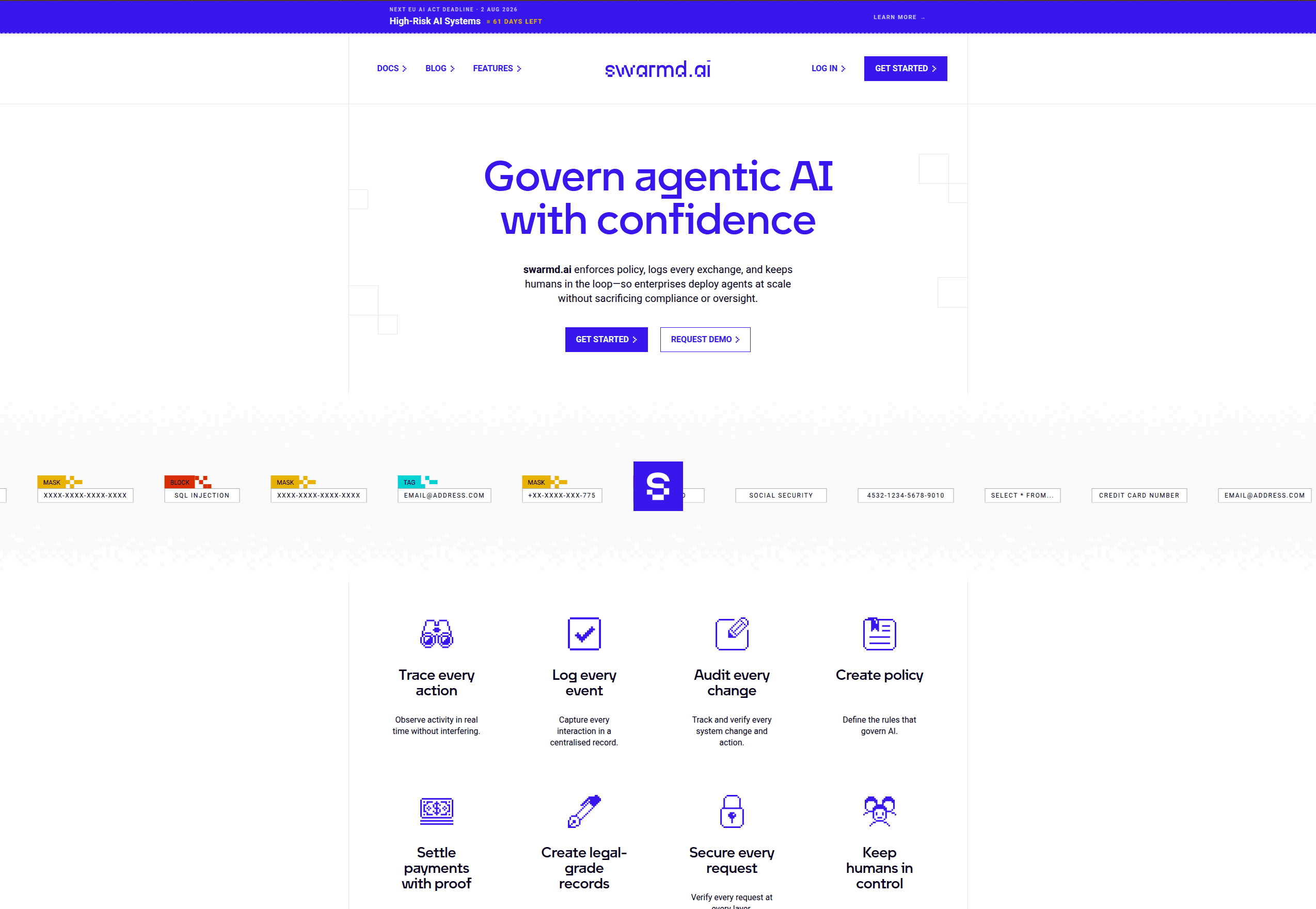
swarmd.ai: from a blank page to paying enterprise customers in six months, 75% under budget
Hexploits designed and built swarmd.ai end to end: nine services in production, policy-as-code, a tamper-evident audit trail, per-tenant isolation and customer-owned identity, built in from week one because enterprise buyers ask for them before they ask for features. Delivered 75% under the original budget and 75% ahead of the original timeline.
How success is measured
Every engagement agrees its measures and the measurement period in writing before work starts.
- Time from blank page or prototype to first paying customer on the production product.
- Release frequency and time to ship a change, measured after launch.
- Availability and response times against what the first enterprise contract requires.
- Infrastructure cost per customer, so gross margin is known before the sales team promises it.
Proof
Case studies with numbers, and reviews linked to Google where they were left there.
swarmd.ai · Software vendor · 6 months
Enterprise AI control plane delivered in six months at 75% under budget for a UK software vendor
JobVantage · Recruitment technology · Duration TBC
99.9% availability and sub-100ms responses for a recruitment intelligence platform, at negligible infrastructure cost
Director, JobVantage
“Working with Hexploits has genuinely been a pleasure, and I see them as my scaling partner for the foreseeable future as JobVantage grows. If you’re looking for a development team who combine strong AI/engineering capability with honesty, flexibility and a real interest in your business, I’d strongly recommend them.”

Director, PeppaSync
“Hexploits have been a breath of fresh air on Peppasync, an AI/ML autonomous decision platform for commercial leaders in retail and ecommerce. The depth and thoroughness the team brought to design and architecture was second to none.”

Questions we get asked
Should we rebuild or fix the prototype?
How do we avoid over-building?
What does it cost?
Who owns the code?
Can you work alongside our engineers?
Related
Sectors where this is most often needed
More in product engineering
Web platform and portal development
Legacy system modernisation
Systems integration and API development
From spreadsheets to systems: automating the processes your business runs on Excel
Internal tools and workflow software
Software rescue and stabilisation
Automated testing and release engineering
Core payments engineering: Faster Payments, BACS and SEPA
Payment and compliance integrations: Stripe, Adyen, GoCardless, KYC and AML
Payment gateways, routing and orchestration
Technical due diligence for founders and investors
Next step
Request a proposal.
Tell us about the system and the sector. A named engineer replies within one working day. A written scope and an indicative price within two working days of a short scoping call.